Breaking News: PN strike off - news updates to follow

Wednesday, 30 September 2009

Lady Liberty Calls

If there is one thing that never ceases to capture the human mind - it is freedom and liberty. And the national monument of the Statue of Liberty - Lady Liberty, the enlightened one still holds her torch for liberty just south of Manhattan in NY. From 1886 to 1902 functioning as a lighthouse.


Today, the original flame has been replaced, but the original flame can still be seen in the basement to the entrance of the museum within the sculpture itself.


The enlightened Lady Liberty from 1886 conceived by French sculptor Frédéric Auguste Bartholdi is enchanting because of the mystery that surrounds her and the Freemason sculpture and building. With the significant seven rays in her crown to symbolise enlightenment.


And now for the enlightenment paradox: Although I felt much more enlightened after a trip to the museum, sadly you have to book way in advance to get all the way up to Lady Liberty's crown, so I wasn't fully enlightened on this particular tour. Next time...

Kandinsky At Large

Right next to Central Park on Fifth Avenue in NY is the amazing Guggenheim museum. Named after founder Solomon R. Guggenheim. He started collecting Vasily Kandinsky paintings in 1929, and I was in luck to be in NY just as a very comprehensive Kandinsky exhibition opened for the 50th Anniversary of the Guggenheim.

In particular, it included his paintings and his amazing water colours from the founder's and from the Hilla Rebay collections. The exhibition runs from 18th September 2009 to 13th January 2010. This is an exhibition that I would very much like to revisit.

For further information, please see:
http://www.guggenheim.org/new-york/exhibitions/on-view-now/

SG Encounters

News about the Iranian uranium facility were the topic during a UN press conference Monday with the Turkish Secretary General Ihsanoglu of OIC (Organisation of Islamic Conference), representing 57 member states with at least 50 percent Muslims, and is the second largest international organisation after the UN. He responded to the questions about the facility and of possible sanctions towards Iran:

'Any country has the right to produce safe nuclear power. IAEA, the international atomic energy agency, should be the decisive authority. And there should be no double standards. Neither towards Iran nor other countries. Sanctions won't help, because they also affect populations. As we witnessed in Iraq. And we shouldn't repeat mistakes from Iraq,' was the immediate response from OIC Secretary General Ihsanoglu.

To the specific question of a harder line towards Iran from USA, he mentioned that with the help from ambassador Dr. Ali Akbar Salehi, assistant Secretary General for science, technology, cultural and sociale affairs in OIC - a man who also happens to be from Iran - has investigated the recent information, and that Iran had already briefed IAEA about the uranium station. So eventhough the OIC Secretary General saw no problem in casu Iran, he did express an understanding for the worry from the international community, that nuclear weapons might fall into the hands of the wrong states.

'We don't want to be taken hostage to the fanatics,' the OIC Secretary General stated.

When the same question was posed to UN Vice-Secretary General B. Lynn Pascoe at a later press conference at the UN, he expressed himself in a more balanced way.

'We are against the spreading of nuclear weapons, and we want to promote the ideal of non-proliferation. We lean on the IAEA. There is nothing new in our position, it has been consistent. Iran should respect all of the resolutions by the Security Council, and should negotiate effectively. We don't believe in sanctions,' B. Lynn Pascoe stated Monday on behalf of the UN Secretary General, before his press conference Tuesday.


The press conference Tuesday was set from 10-10:30 am, but exceded the time frame by ten minutes. And the questions were mostly about the uranium facility in Iran. Apart from a few questions about the situation in Afghanistan and Somalia. About the meeting between the UN Secretary General and Ahmedinejad, the UN SG took on the same diplomatic approach as the UN Vice-SG:

'I encouraged him to open to the full inspections of the IAEA. I encouraged him to take on a constructive role. When he argued for a peaceful use of nuclear energy, I said that Iran has the burden of proof. I said to him, that despite this good conversation, there was still a gap in the mutual understanding. I encouraged him to bridge this gap. I am to meet with the Iranian leader again later today. This meeting will be on topics like nuclear energy, food security, powerty, and other topics. But I can't reveal more about the contents of a private meeting with Ahmedinejad,' Ban Ki-moon (sic!) stated.

Cable News

Arabs At Large

Outside the UN building on Manhattan in New York an estimated 20.000 people had gathered to protest for very different reasons.

There were widespread protests against the participation at the UN meetings by Libya's Muammar Al-Qaddafi (Qaddafi), leader of The Socialist People's Party Arab Jamahiriya. One group was there to protest against Qaddafi's presence and to ask for the release of Sayed Musa Al-Sadr from prison, who was kidnapped during a visit to Libya in 1978 and imprisoned, and who many view as the Gandhi of the Middle East. Another group called Nation of Islam leans on orthodox Islam, that from 2005 established so-called hate groups, welcomed Qaddafi to the UN.

Another group protested against the participation by the Iranian president Mahmoud Ahmedinejad at the assembly, because he ’has blood on his hands’ and the lives of many Iranian people on his conscience.

United But Divided

In New York on 21st September, on the eve of the UN Secretary-General's Climate Summit, The Alliance of Small Island States/AOSIS convened a one day High-Level Summit on Climate Change. Paradoxical News was there to cover the meeting.

The demand from AOSIS was that the UN Summit on Climate Change in December take into account their vulnerable position. With some island states, like pacific Nauru, the highest point above sea level is about 12 metres. Which means that they will be flooded when the effects of climate change sets in.

With the president of the Maldives heading their representation in demanding that global temperature increases be kept as far below 1.5°C as possible to limit the anticipated devastating effects of climate change on the world's most vulnerable countries. These are also to a far extent some of the poorest countries. This puts pressure on the leading UN economies at COP15, come December 7th-18th, since the goal to be met has been suggested at a maximum increase of 2°C. This leaves the United Nations split before the Copenhagen summit. United but divided.

For further information about AOSIS, please see:

http://www.sidsnet.org/aosis/

Sunday, 27 September 2009

NY Scenes - Part Two

Central Park in NY is the centre of leisure for most New Yorkers. It breathes. And it makes you feel comfortable in a very busy city. This is a view of the park from one lake towards the luxury flats on Fifth Avenue.


I stumbled into this odd couple on Fifth Avenue during the annual Steuben Parade, which takes place every year in September to celebrate German-Americans.

And if you weren't around for the historic Boston Tea Party, you can always enjoy Alice in Wonderland and her mad tea party friends of The Mad Hatter and The Chessire Cat among others. Sitting at the centre of the park close to a lake and The Boathouse restaurant.


Or you can slip on your 80ies bandana and enjoy a disco moment with these guys...

NY Scenes - Part One


Funky drummers. This was one of the first things that met me on Times Square in NY. And what more do you really need than an old green bucket to entertain crowds of cheerful bypassers? This bucket master was born to drum.

Saturday, 26 September 2009

An Apple A Day

An apple a day keeps the doctor away - if you can hit him, that is. Paradoxical News has taken the full consequence of this old saying and taken a huge bite of a fresh apple. The big one. More paradoxical news to follow as a result.

Happy 1st Anniversary Paradoxical News!

Paradoxical News has the priviledge to announce its 1st anniversary today. And at the same time the great honour to announce that PN just won The Big Murphy Prize - an Against All Odds award given for perseverance and dedication in producing paradoxical news on limited funds, employees, and time. PN couldn't have done this without the help and support from an endless list of people.

Please see the THX Alternative Award Speech list below:

Paradoxical Update


Monday, 14 September 2009

The Silver Handbag Prize 2009

Yesterday former Secretary of State Uffe Ellemann-Jensen from The Liberal Party of Denmark (V) was awarded the Silver Handbag or Marianne Prize 2009, so named after former party leader Marianne Jelved from The Danish Social Liberal Party (B).

The event took place this weekend at the Social Liberal national congress on the mid-Denmark island of Funen. Aptly so to build bridges in Danish geography as well as politics.

The award was motivated by current Social Liberal party leader Margrethe Vestager:
'His opionions are characterized by freedom of speech, equality for all, respect for minorities, and tolerance. So much so that he has been accused of being 'just as bad as a Social Liberal person'.'

Why the handbag is merely cast in silver is unclear. But as the old saying goes, Speech is Silver, Silence is Golden - it fits the prize winner, who puts his nose into everything, speaks out on any political issue, and can't be stopped. Always in a forward fashion. Which is very un-Danish as most Danes go. This has earned him the nick name of The Big Nose, and he also has several Big Noses to his name - which is a term for a political blunder, and the opposite of an award - some of them even with Social Liberal votes. He even sticks his nose out a decade after his leadership of The Liberals and his high ranking position in Danish politics. Why he was never appointed Prime Minister was once pinpointed by former PM Poul Schlüter from The Conservatives (C) when asked if Uffe Ellemann-Jensen could someday become PM: 'Yes, maybe - but not in Denmark'.

After receiving the prize, the prize winner Uffe Ellemann-Jensen responded to Paradoxical News:
'It's a reminder that you can't trample the Social Liberals under foot, and I think awarding me was quite Liberal and broad-minded.'
Thus referring to the current political position of the Social Liberals after being dumped by the two major opposition parties.

Among other things Uffe Ellemann-Jensen was suggested to use the silver handbag for storing all of his Noses. And Marianne Jelved herself commented on this:
'He always leads. And is not afraid of being unpopular and taking the hits in battles. The Noses haven't all been fair.'

Friday, 11 September 2009

Meta-Comment No. 11

10.000 billion. That's right - you heard it first here: There are about 10.000 billion reasons why Paradoxical News was founded. For one, people don't appreciate real news. They don't even want it. They demand virtual news. Paradoxes. Games. So that's what they will be served in truck loads at PN. Paradoxical News has played along to the market demands the whole way - from fully and completely, to semi-participating, and has even tried to abort the news market completely. With no such luck. So the paradoxical status on this 9/11 is: The worse it gets, the better it gets.

Tuesday, 8 September 2009

To Move On From a Nasty Break Up

I'm sorry for the less fluent flow of Paradoxical News lately, but immediate action for other crisis matters has been necessary. On Friday last week The Social Democrats (A) and The Socialist People's Party (F) made their romance clear to everyone, as they dumped The Social Liberals (B) for their closer commitment up to their state budget proposal.

Party leader Margrethe Vestager from The Social Liberals has taken it nicely. She's confident that this new late summer romance will pass after they both wake up to realities after an intense honeymoon. And convinced that they will all talk and bond again in the new season this fall.

Right now the polls couldn't be worse for Margrethe Vestager and The Social Liberals - with only a few percent supporters for her government leadership. But the thing is, The Social Liberals have always had support from just about five-seven percent - and has never been in play for the position of PM. So for the very reason that she's taking these severe punches with a smile right now, and the current polls aside, Paradoxical News predicts that in probably less than two years she will have a high ranking ministerial position. Because she never fails to believe in negociations. And in building bridges. The very stuff that parliament is made of.

A State Budget Paradox

Today, Paradoxical News tried to cover the first draft of the negociations for passing the state budget for 2010. 'Tried' is the operative word here. Two weeks ago the budget proposition was made by the Minister of Finance (covered in a different connexion). And this past week and the week to come the opposition and other parties give their proposals. Today, the debate itself more had the characteristics of a rhetoric exercise to get in shape again - after a long summer and all. On both sides, the opposition and the supporting party want to speed up the public spending and investments to produce more jobs. Apart from that not much new was said, with the government and opposition parties blaming each other for economic set backs. Hopefully more substance will come at the real opening in October.

Glance, Bang Bang

Yesterday a friend made a sudden suggestion to go to an album release venue and to hear/see the duo Mads Mouritz and Lone Hørslev perform tracks from their new album Blik, Bang Bang (roughly: Glance, Bang Bang) in Huset i Magstræde in Copenhagen. The concert had a very independent singer-songwriter, bluesy feel to it, and was all done laid back and in very good ambience. And paradoxically no Bangs.

Try this for a taste (and below for further information):
http://www.myspace.com/mouritzhoerslev
http://paradoxicalnews.blogspot.com/2009/05/poetry-framed-in-music-two.html

Friday, 4 September 2009

A Michael Jackson Paradox

Whenever news about Michael Jackson emerges, I don't believe it. Like so this summer. Whatever you hear, trust me, he lives on.

Friday, 21 August 2009

Hard Head, Soft Heart

Paradox status:
Sometimes you must go down to step it up. Sometimes you have to take a step back to get forward. And sometimes you have to make a major detour to get home.

Thursday, 20 August 2009

A Helicopter Perspective


If Mother Earth can grab us this much, why don't we take better care of her? This is the paradoxical focus of the documentary Home. You see, sometimes a helicopter perspective of things is helpful. Last night i viewed the Home project by renowned French photographer Yann Arthus-Bertrand at Cinemateket in Copenhagen, with representatives from UNFPA/United Nations Population Fund, WFP/World Food Programme, and EEA/European Environment Agency present to take questions afterwards. The purpose is to create awareness about the effects of climate change on the blue planet.

The documentary of planet Earth seen from the sky is a breathtaking film, with astonishing images and a dramatic narrative voice to fill in the statistics. And although the statistics flew by much faster than the helicopter, the impression made by Bertrand's documentary is permanent. Hopefully the impression lasts enough for world leaders to take appropriate measures at COP15 in December to stop the above two percent warming catastrophic effects. Please go see.

For further information about the Home project, please see:

Wednesday, 19 August 2009

Intolerance

Last night a concert was held at Rådhuspladsen (City Hall Square) to support asylum for 282 Iraqi refugees, that have been rejected by the Danish refugee authorities. A six hour long event with many of the best names in Danish music. Among them Trentemøller, Lars H.U.G, Simon Kvamm, Niels Hausgaard, Sebastian - and many more. They were there to put the focus on tolerance under the slogan of 'If there are rules in effect that contradict humanity - it's not humanity that is the problem.'

The 282 Iraqi refugees have been thrown out of a Danish church where they had spent a few months in protest of being rejected, because Iraq still isn't safe to return to. They have now been thrown out of church and into confinement. Every human rights body from a Danish center for research in torture victims (RCT), Amnesty International to UNHCR have protested that throwing them in confinement is at odds with the torture paragraphs in the UN Human Rights Convention.

Even voters are against this government policy with about 80-90 percent in the opposition parties, and even within the government's own electorate, with close to 60 percent against this policy. Despite this the Danish government and the Minister of Refugee, Immigration and Integration Affairs, Birthe Rønn Hornbech, stand firm on the issue referring to Danish law and rules. With an indictment from human rights associations as a result. Paradox: Have rules become more important than humanity and tolerance?

Tuesday, 18 August 2009

Come Home

Is there a nice person out there to help Naser Khader back on track? This genuinely sympathic Danish politician has undergone political changes as seen nowhere else these past few years. With points of view ranging from Social Liberal to Centered Democratic over very-very Liberal to Conservative and lately to Right wing People's Party views. Latest on his suggestions to ban Muslim religious head wear, in particular burkas and nijabs in public areas. Whereas chadors and hijabs, where you can still see the faces of the women are more suitable. For the sake of the women and their limited options on the job market - in order to ensure better integration.

One thing is that private and public employers won't accept a totally covered employee, but to ban the veiling in public areas is more controversial. And has sparked a heavy debate lately, in particular from the opposion parties of The Red-Green Alliance (Ø), The Socialist People's Party (F), The Danish Social Liberal Party (B). And even from government and government supporting The Liberal Party of Denmark (V) and Liberal Alliance (Y). Surprisingly The Social Democrats (A) support it. With The Christian Democrats in Denmark (K) oddly missing in the debates. But with accusations flying that Naser Khader has not only placed himself to the Right of The Conservatives (C), but has even pushed The Danish People's Party (O) to the Right.

Naser Khader, please look up the best possible navigator to bring you HOME.

For further information about Muslim religious head wear, please see:
http://www.apologeticsindex.org/505-muslim-veils-hijab-burqa

For further information about the Danish political debate, please see:
http://politiken.dk/politik/article769206.ece

For further information about the Danish political parties, please see:
http://paradoxicalnews.blogspot.com/2008/10/cliff-notes-to-danish-politics.html

Friday, 14 August 2009

An Election Paradox

You may be mistaking, Jon. Politics is not about winning the polls - but winning the election.

Paradoxical News in Dire Straits - Part Two

Intranet: Since the onset of the seven - at least! - combined crises Paradoxical News has been in dire straits. Please see the weekly letter of Ugebrevet Mandag Morgen in the fall of 2008 for an in depth analysis of the seven - at least! - interlinked crises.

The editor-in-chief of PN would like to express gratitude to its shareholders, advertisers - and first and foremost to its work force with the following statement:

'There are no words to express how hard all employees at PN have worked these past few years. They have suffered economically, taking tremendous cutbacks and working in all fields to pull PN out of the crises. And I think we have the hardest working journalists in the industry,' the editor-in-chief of Paradoxical News says.

So much for past history and bumps along the road. They have caused severe setbacks. However, the editor also looks to the future for hope and change:

'PN is in dire straits - and has been for quite some time. But I believe we have hit rock bottom now, so the only way is up from here. PN has unique qualities, and PN has the strongest network of any contender out there on the news market - a more convincing network than any other contender I know. These unique selling points will pull PN through,' the PN editor-in-chief claims.

Paradoxical News in Dire Straits - Part One

Globally: Paradoxical News is in dire straits. Since the onset of the seven - at least! - combined crises beginning in 2008, your niche publication of choice has been hit hard on several occasions. This summer Paradoxical News had to adjust its expectations for 2009. And in July the editor-in-chief of PN announced a relocation to an interim HQ, the contract of which expires this weekend. Today, PN is urgently looking for a more permanent place for its HQ - and will be searching the usual prime site for immediate options. In the finest Cavling and public journalism tradition the editor is calling for help from its permanent readership: If anyone has ideas, please let the editor of PN know.

Lemonade

And now for the food section: If you squeeze a lemon hard, will it not juice? I'm sorry for the paradoxical paraphrasing here, I am but a thief of words. Try this for an experiment: Cut a lemon in two halves. Leave one half, only squeezing the other to its max into a glass. If the experiment works you will now have a glass of wonderfully refreshing lemon juice. And one half of fresh lemon bursting with juice - still there for the taking. Now have a look at the squeezed lemon. Do you like the appearance? Does it appeal to you? Can you use it for anything? Just one of those food section paradoxes. Enjoy your juice.

Monday, 10 August 2009

Meta-Comment No. 10

Looking for paradoxes? Sometimes you should have been at a certain place at a certain time. And you really, really wanted to. But you just weren't. Today was one of those very sad times. So you may have given up. I need to be somewhere else.

Wednesday, 5 August 2009

Be Careful What You Wish For

Right...
Be careful what you wish for, you just might get it - a sharp man once told me. These past few days the media have been swamped with the always lovely - though very opinionated - Pia Kjærsgaard, leader of The Danish People's Party (O). Who now wants to decide what is art and what is not. And though her opions are always enjoyable to hear, because they in the most paradoxical way help you make up your own mind - perhaps this is not her most prominent field of expertise. As discovered and debated by artists and media people alike. So this time I close my eyes and my ears - wishing for the opposition to emerge in full and take part in the debate. And simply a full range of politicians. Please don't be 'gone'...

Tuesday, 4 August 2009

The Ultimate Politician

Today's paradox: Isn't it odd that someone has to leave politics for every other politician to voice their support and be in unison - independent of political colour? It would seem that the ultimate politician is neither Left nor Right - but simply gone...

To The Lighthouse

This is not an ode to the Virginia Woolf novel, but to a Social Democrat (S), former Minister for the Environment and Vice President of the Danish Parliament, Svend Auken, who stood tall in more sense than one. For his beloved wind mills. In politics. In real life.
Photo provided by:

Thursday, 30 July 2009

Balance Acts

Just for the balance of things. There are several ways of expressing yourself. Or enjoying others expressing themselves. If you are in Copenhagen and looking for something to do this weekend, why don't you try this site for inspiration:

A Paradoxical Fan

Yesterday I caught myself getting anoyed. I may even have cursed. Luckily I did so with no one else present. I let myself blame The Danish People's Party (O) for all things bad in our society. The severe surveillance that I don't think becomes a free, open, and modern society. That control should be better than trust? And I blamed the party and its heavy influence for the past eight years for this.

Later I laughed at myself. I let the party get to me. What does that mean? It means that they have a democratic justification. With varying polls showing that 12-17 percent of Danish voters support them. The party keeps the democracy alive and kicking. They make people think and form their opinions. They fuel debate. In short, they work. With party leader Pia Kjærsgaard never failing to tune into the feelings and frame of mind of the party's electorate with close to a hundred percent precision. Never failing to cover the base perfectly. Isn't that what democracy is all about? And imagine getting anoyed with this adorable iron lady who gets away with practically anything in politics? I'd rather interview her, as a very unlikely fan.

For a more elaborate overview of the Danish political scene, please see:

A Modern Pretorian Guard

Here, there, everywhere. Have you noticed the growth in security firms and surveillance companies during this past decennium? They are in stores, in all forms of transportation systems, hotels, airports, in our mobiles, GPS, ATM's, our work places - and what the heck, why don't we even allow them into our private residence areas? They tape us and own the rights to the tapes. To protect us, naturally.

One of these companies, beginning and ending with a letter and a figure interfixed, has grown out of absolutely nothing for the past eight years through acquisitions. I even saw them at the municipality job centre. Three man tall sitting lazily around reading newspapers the entire day - when not doing an hourly round to watch over the job seekers at the computers. Or filling paper into the printers. Three man tall, full time, doing the job of a part time page girl. The paradox is: there are never any incidents to justify their presence (one such could of course be staged to justify the need for them). And I'm sure that they could be called - or rightly so, the police - if needed. Imagine the amount of tax dollars that go into these guards reading newspapers the entire day.

I say, with this constant eye in the sky - why don't we join in the game? Have some fun with this East block method. Let's start watching these guards closely. Just a taste of their own methods. Little Brother style.

Sunday, 26 July 2009

Meta-Comment No. 9

Do you know the feeling when you want to express gratitude, but you can't find the words? Or can't reach the ones you want to thank? The frustration of it? Here goes, without words it comes out something like this: *PB#JS%SC@!

Wednesday, 15 July 2009

Homophobic Paradox

Most men enjoy watching two women kissing. I'm not sure that the case is the same when reversely women watch two men kissing. Personally, I don't mind it either. Good for them, I think. But in the 21st century homophobia still keeps the Copenhagen Metro Company from showing the winning film from the short film festival 60Seconds - because it might offend people. Eventhough the Copenhagen Metro Company co-arranged the festival. Two men kissing. Big deal. In a shower - but from the waist up. In these CO2 awareness times, aren't they doing the politically correct thing: shower with a friend!

Watch and decide for yourself:

Sunday, 5 July 2009

Walter Russell Mead in Town

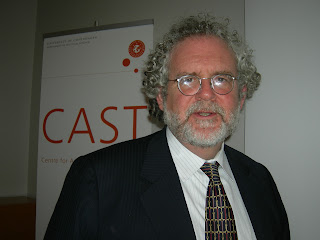
11th June American historian Walter Russell Mead, a Henry A. Kissinger fellow for American foreign policy at Council of Foreign Affairs in NY, gave a lecture at CAST/Centre for Advanced Security Theory at University of Copenhagen.

Where he also gave an interview. One of the points was that an American president had more or less four strings to play in exercising American foreign policy:

  • The Hamiltonian - Goal: to develop world trade and commercialize countries
  • Based on Alexander Hamilton. The initiator of the American Constitution under first US president George Washington.

  • The Wilsonian - Goal: to change the world and to develop democracies worldwide
  • Based on Woodrow Wilson. US president 1913-21 and initiator of the UN forerunner, Leage of Nations.

  • The Jeffersonian - Goal: to ignore the world and to ensure freedom/security at home
  • Based on Thomas Jefferson. The architect behind the Declaration of Independence and third US president.

  • The Jacksonian - Goal: to protect American interests by force if necessary
  • Based on Andrew Jackson. Seventh US president, American General who drove native Americans to the West.

"Obama's approaches in foreign policy are deeply rooted in these four schools. If you read his speeches with these four schools in mind, you'll find that he is something of a violinist. And although he seems to hit the Jacksonian string less - he does hit it," Walter Russell Mead claims.

His point being that any given president will change his role during a presidency, based on circumstances. From the universally open role to the realistic-cynical role when the United States is threatened. Even Obama, if faced with threats to mainland USA or the Americans.

"Suppose the Iranians respond to his ouvertures and it all goes very nicely, we would get one kind of approach. But if they keep testing missils and get closer to a bomb, we could see another approach. And it's interesting that every time he's asked, Obama says, 'I don't take options off the table'. Unlike Bush, he doesn't go around saying it all the time, but if you ask him, that is what he will tell you," Mead stresses. Paradox: Different package - same contents.

Interview Project

The hiatus at Paradoxical News was also spent continuing the interview project about journalism and the use of sources, and more interviews are lined up in the nearest future. To the benefit of the readership of Paradoxical News.

Paradoxical News Hiatus

The permanent readership of Paradoxical News will have noticed a break in the segments. This hiatus was spent moving HQ. The editor of Paradoxical News is sorry for any inconvenience this may have caused, and would like to express gratitude to its readership for the patience shown during this period.

Sunday, 7 June 2009

Party Leader Debate

The elections for both the EU Parliament and regarding gender equality in the right to the Danish throne ended up in a debate between the party leaders, hosted by Lotte Mejlhede/TV2 and Kim Bildsøe Lassen/DR1.

First up was Margrethe Vestager from The Social Liberals (B) - since her party has fought hard to make the change in the Constitution not only to be about gender equality to the throne, but a more complex modernisation - including a review of the fundamental rule and of a more expressed inclusion of human and civil rights into the Constitution. A comprehensive modernisation the party before the election now saw as being very slim. Therefore members of the party had opted for giving blank votes on this issue.

So, not for being against gender equality on the throne - but for the above reasons, Margrethe Vestager was asked to explain the party's lack of success in convincing the electorate (The Social-Liberals ended up 'losing' both elections). And to explain the paradox: were there - in fact - many republicans within her semi-liberal party
?

The Liberals

Second in line in the European Parliament/EP were The Liberals (V) with oddly 20 percent of the votes and three out of thirteen mandates. PM Lars Løkke Rasmussen was happy to announce progress since the last elections (less than one percent), thanking voters. And also celebrated the gender equality for princes and princesses alike - when it comes to access to the Danish throne.

Lars Løkke Rasmussen then handed the microphone to new EP member and former liberal spokesperson Jens Rohde, who also thanked the voters and more or less commented on the same issues (apart from a later warm thank you note to his wife - also a building constructor at home - for her strong support):

The Social Democrats

The Social Democrats (S) were topscorers at the EU election, although they had to take a beat from the last EU elections. Party leader Helle Thorning-Schmidt thanked the many supporters and first candidate Dan Jørgensen for his hard work - and became the overall winner of the election to the European Parliament/EP.

Dan Jørgensen in turn thanked his party leader and former Prime Minister and later EP member, Poul Nyrup Rasmussen, who supported his campaign with posters reading 'Do like Poul, vote for Dan'. Well, although this received many laughs along the campaign, many actually did - a reference he made during his thank you speech below:

Historic Elections: EU and The Danish Throne

Sunday 7th June 2009 is a historic day in many senses: Today, during the two elections we had to make a choice about changing one single part of the Constitution, in order to assure gender equality between princes and princesses in the right to the Danish throne. At least 40 percent of all had to vote YES to the ammendment to the Constitution. 45,5 percent did - so we now have gender equality on the right to the throne. The elections day had a historical turnout of about 59,5 percent of the population.

And another choice of members to the European Parliament (EP). Of other historic results were that The Social Democrats (S) had to take a fall of about 11 percent, but still came out as topscorer with 21,5 percent of the total votes. With The Liberals (V) in the second place with 20,2 percent. The real surprises were The Danish People's Party (O) in the fourth position, but the highclimber of the day, with a progress of 8,5 percent more votes than at the last EP elections. And The Socialist People's Party (F) in third place, but with a progress of 7,9 percent more votes than at the last EP elections. Actually 'stealing/buying' votes from the EP coalition partner of The Social Liberals (B), that didn't manage to get into the EU Parliament this time - with a fall of about 2 percent.

And very-very historic: the center EP party of the June Movement (so named after the 1992 Maastricht treaty election, that took place in June of that year) also didn't manage to get in. They have existed for almost 16 years, founded in August 1992) - but had to take a severe fall of 6,7 percent of the votes. The president of the movement would later announce that it didn't make sense to continue as an EP party. So now we only have two parties of the listed nine choices to fight the EU from within: The Danish People's Party (O) - and The People's Movement Against The EU (N for NO), that - just - got into the EP with 7,2 percent of the votes, and one mandate of thirteen.

The paradox being that Danish nay-sayers have been well-represented all along - up until yesterday with three of the listed nine parties aimed at fighting the EU from within...Very Danish.

Here are results according to the Danish media:
http://www.dr.dk/Nyheder/Temaer/2009/Europa/?v
http://politiken.dk/system/topicRoot/Valg_til_EU-parlamentet_2009/
http://www.berlingske.dk/article/20090608/epvalg/90608062/

Civil Rights on Constitution Day

Isn't it odd that when you really need a lawyer that you can't even get to one? For the past couple of years I've tried to get legal counsel on numerous occasions. First, my application to the union kept 'disappearing' - for months. Once in the union I spent several months trying to get legal counsel there - in vain. Due to a very busy secretary who demanded to know - not just in main points, but in full detail - what I wanted to talk with the lawyer about. In full detail? Isn't that priviledged information between the lawyer and the client?

Then I tried a civil rights specialist lawyer, because the above incidents themselves woke me up. Again, a very busy secretary hindered my access. Probably also part of her job. Busy lawyer and all. But what cannot be part of her job was, that she referred me to two different so-called lawyers - whose names I later checked. There were no such lawyers in the lawyer lists. Reversely checking the addresses, there were not even any kind of legal company there. Lastly, after a couple of years of trying to get access to a lawyer, I tried a free of charge legal counsel service - no help, too busy, not even a referral. Isn't it odd though, and isn't legal counsel a civil and human right? Just paradoxed on Constitution Day!

Friday, 5 June 2009

More Civil Rights Celebrations

President Ole Egelund of the association of Forældre mod Politibrutalitet hands the torches to the joggler
Constitution Day should be a celebration. And it truly turned out to be one. As if the musicians managed to drive away the heavy midday rains, the sun broke out, the barbecue was lit - and the joggler started his show. Kindly assisted by parent members from the association of Forældre mod Politibrutalitet (parents against police brutality) - lending him their thighs to stand on.
Before everybody joined in the - very Danish - dancing in circles. All in all a very merry Constitution Day Celebration.


Civil Rights Celebrations

'Sentences should not be given in the streets', 'Hippie bashing should be stopped', 'The police act as gang members' - were some of the one-liners delivered by the association of Forældre mod Politibrutalitet (parents against police brutality).

They referred for one example to the demonstration for Palestine in Copenhagen 13th January this year, where demonstrators were detained - under a paragraph in the law giving the police the right to detain demonstrators for upto six hours under unrest - thus enacting detention in the streets. With no civil right like the right to speak to a lawyer. And as if some superior power heard this, the heavy rains set in during this Constitution Day event. Still, not preventing the group from enjoying and celebrating the day.

Constitution Day Celebration

Today is Constitution Day in Denmark. We celebrate it every year on 5th June with speeches and events around the country.

The constitution was signed on 5th June 1859 by then absolute ruler, Frederik VII. Hereby creating the limited Monarchy we know today - with the Danish Parliament as the legislative assembly, and reducing the monarch to a more or less ceremonial figure.

One of the events took place in the Copenhagen park of Ørstedsparken. The event was arranged by the association of Forældre mod Politibrutalitet (parents against police brutality). It was founded in 2006 after an anti-nazi demonstration that got out of hand with conflicting groups. The members had many other examples of misplaced use of brutality by the police within the past years - latest during the World Business Summit on Climate Change in Bella Center end of May. Therefore, the association presented its main speaker, lawyer Michael Bjørn Hansen, from the law firm of Christian Harlang, specialized in civil rights cases. He spoke up for the right to demonstrate. And against the brutality of the metods used by the police in dealing with demonstrations of various kinds.

One point he made - on this Constitution Day - was that there is actually no demand in the Constitution for the prior announcement to the authorities (police and others) before a demonstration. This is merely a practical arrangement in order to control the potential negative side effects of demonstrations - if they get out of hand. Actually, he pointed out, demonstration is a civil freedom right. Delivering the paradox of the day: the Constitution and the laws of the country should protect demonstrations - rather than control them. Since demonstrations are often the only measure to voice opinions for the week in society. He harvested many cheers and applauses for his help to the association. Which he in turn returned with thanks to the association for gathering examples and cases.

Tuesday, 2 June 2009

Nicaragua in Political Quicksand

Here we go again: the Nicaraguan government - and even the opposition parties - enters quicksand. This according to Centro de Investigaciones de la Comunicación (CINCO) in Managua, that investigates and forecasts the climate for democracy, government, the media, and political culture in Nicaragua. Reflecting on the past 2½ years of FSLN government under Ortega, since the november 2006 elections. In the latest issue of the analytical political publication of Perspectivas/Boletín (Edición 32), CINCO asked the population of Nicaragua seven questions:
  • Has Nicaragua become more democratic?
  • Do the institutions function better?
  • Does the population have more confidence in them?
  • Have relations between government and society become more transparent and better?
  • Does the country (Nicaragua) enjoy more international legitimacy?
  • Has the social and economic situation improved?
  • Has the population more positive expectations?
CINCO notes that the responses varies from political colour of the respondents, but overall the population feels set back. According to CINCO, one of the major political problems is that FSLN/Frente Sandinista de Liberación Nacional and PLC/Partido Liberal Constitucionalista since the onset of the so-called pact (El Pacto, formed in 2000) controls everything from government institutions, like the legislative institutions, supreme court, and the supreme electoral council. And that FSLN and PLC controls the network of cadres of the local municipalities (los caudillos, so nicknamed after Spanish general Franco - El Caudillo).

So the government sits in quicksand, because the economic situation is continuously worsened. Partly due to sanctions from the international community, partly due to promises of financial assistance from Venezuelan President Hugo Chávez - that just haven't materialized. Meanwhile holding the public institutions and the population hostages.

So the opposition also sits in quicksand - due to lack of political or institutional influence. What CINCO suggests is for the opposition to unite more strongly, with the intellectuals of the left wing parties of MRS/Movimiento Renovador Sandinista and MPRS/El Movimiento por el Rescate del Sandinismo (or simply El Rescate). CINCO criticizes the opposition for not presenting a coherent political plan or strategy - encouraging them to sharpen their profile and focus on the civil rights of the population. And to form a coalition much like UNO/Unión Nacional Opositoro did in the historical 1990 elections, backed by the USA, when Violetta Chamorro managed to overthrow Daniel Ortega and FSLN with 55 percent of the votes to Ortega's 41 percent.

With less than one in ten votes there seems to be a bit of way to overthrow Daniel Ortega and FSLN, unless they manage to bridge all the way to one of the liberal parties - PLC that also calls itself opposition, despite El Pacto - this is the real paradox in Nicaragua. ALN/Alianza Liberal Nicaragüense already formed an alliance with PLC/Partido Liberal Constitucionalista during the 2008 municipal elections - so what the opposition parties do have in common is a critique of the frauds during these elections. And what CINCO suggests is to mobilize and to ride the waves of a wider protest of the government in the population. Ay-Ay-Ay, the quicksand keeps spreading.

For further information, please see:
http://www.cinco.org.ni/publicaciones/

Monday, 1 June 2009

Emission Omission

It's not in the measurement itself - it's in the reading. The European Environment Agency/EEA just held a technical press briefing to report the latest results from the analytical department of EEA - on greenhouse gas (GHG) emissions of the collective EU member states. And they were happy to note that for the past three consecutive years (2005-2007) the greenhouse gas emissions of the EU member states had declined.

Below is a graphic display of the numbers. Source: European Environment Agency/EEA 2009. Note that the EU15 (blue) comprises the 'old' EU member states: Austria, Belgium, Denmark, Finland, France, Germany, Greece, Ireland, Italy, Luxembourg, the Netherlands, Portugal, Spain, Sweden, and the United Kingdom. And EU27 (golden) all of them, including the new East Block member states:


Paradoxical News took a hard look at this mildly fluctuating graph and asked itself: If the goal is to reach a 20 percent reduction in GHG emissions below 1990 level by 2020 - and the collective member states have achieved an approximate reduction of 9 percent over the past 17 years - isn't it then very optimistic to hope for a further reduction of 11 percent during the next 13 years? And even more optimistic to promise a joint EU GHG emissions reduction of 30 percent, provided that a global deal can be sealed at COP15 in December (i.e. a further 21 percent reduction by 2020)? When all we could read from this graph were merely repeated fluctuations over the entire period. So their happy note appeared to be more of an Emission Omission statement.

So I asked the members of EEA, among them Ricardo Fernandez (EEA analyst), Dr. Andreas Barkman (head of Mitigation Group at EEA), and their points were these:
  • Since the Kyoto Protocol (negociated in December 1997, and finally sealed in February 2005) countries have introduced legislation to lock the GHG emissions in.
  • Domestic households have introduced GHG saving technologies.
  • Countries and private companies have introduced green energy and overall Clean Development Mechanisms/CDMs (i.e. GHG emission saving technical projects).
  • There has been an introduction of the ETS/Emission Trading System (were GHG emission allowances are traded between member states) to benefit the overall goal of the joint EU member states.
Jan Høst Schmidt (head of the EU representation in Denmark) further remarked:
'We are in a totally different ball game now'

- and referred to EU President José Manuel Barroso's statement, that we have the public and the science on our side now. Compared to 1990 - or even the Kyoto negociations from 1997 onwards. The editor of Paradoxical News is keeping fingres crossed for further GHG emission omissions.

Tuesday, 26 May 2009

Itchy Mother Earth

On a lighter note, Chloe Fox, Parliamentary Secretary to the South Australian Government - ended a session in The Climate Group debate panel during the 24th-26th May World Business Summit on Climate Change:

Two planets in the solar systems are talking with each other. One planet, Mother Earth, says: 'I'm so itchy - what can I do?'. And the other planet says, 'Don't worry, it's just homo sapiens - it will soon drop off.'

A Hot Air Balloon Paradox

Who's to pay? - or rather How to pay? - is the big question in the climate challenge to combat global warming. Or in other words, to pay for the hot air balloon salvation. One of the points repeated over and over again during the World Business Summit on Climate Change is that we need innovative financing. To get a hold of that, we needed to hear the bankers. One very hip way of funding is the mentioned ETS/Emission Trading System and the CDM/Clean Development Mechanism. The financing of which were debated in a working group called 'Carbon Markets', consisting primarily of bankers and regulators. And as was pinpointed by moderator Samuel A. DiPiazza, CEO of PricewaterhouseCoopers International, the toughest challenge is to set a price on carbon. And then there is the 'how to':

Some financial suggestions were put forward by Abyd Karmali, Global Head of Carbon Markets at Bank of America/Merrill Lynch. He mentioned Derivatives, Futures, and Options - and excused himself at the same time. You see, since the onset of the financial crisis these three little words have had a sad connotation. In particular, it is worthwhile to recall the big save of exactly Merrill Lynch by Bank of America's take-over in 2008 - precisely due to the heavy use of the derivatives/credit default swaps, which are basically loan insurances. Bank of America had too high a risk exposure with its investments in Merryll Lynch - and actually had to buy the whole hot air balloon in order not to fall themselves. The credit default swaps/loan insurances exposure, in the case of Bank of America, were close to 40 times above its net worth/equity. This according to the weekly letter of Ugebrevet Mandag Morgen in september 2008 - the very initiator and organizer of this climate summit.

So here comes the paradox: Is it really a good idea to save one hot air balloon (the global warming of Mother Earth) - financing it through another kind of hot air balloon (futures and derivatives)? Abyd Karmali tried to answer that himself: 'We have to ensure a healthy market'. If Merryll Lynch is included in this 'we' is my big worry. And in the response to the same critical question Tracy Wolstencroft, Managing Director at Goldman Sachs, made a point: 'In the US it should be financed through bonds'. Probably in line with the new policies put forward by the current government under Obama. To stop the hot air balloons - financial or climate ones.

José Manuel Barroso in Town

Yesterday José Manuel Barroso, President of The European Commission, was in town. He saw Denmark as a good place to choose for the World Business Summit on Climate Change, because as he stated 'We have two very important things on our side - public opinion and science'. During the summit he came to speak about the European joint efforts towards 2020. And stressed three points:

  1. The EU wants to ensure a comparable CO2 emission reduction, currently set at a 20 percent reduction (according to the 20/20/20 vision), but the EU is willing to set a 30 percent reduction goal - provided that a global deal can be sealed.
  2. Developing countries should do their major part in designing and implementing national low-carbon techniques and economy - and in the EU these vary from 15-30 percent below business as usual by 2020.
  3. The EU will rely on both public and private funding. And carbon markets should be the resource. I.e. through the ETS/Emission Trading System and CDM/Clean Development Mechanism - an initiated 'additional' carbon project that would not have been realized if not for this purpose alone.

To make a note: The variations beween the European countries are great. On the green house gas emission reduction goals towards 2020, they vary between -20 and +20 percent, compared to 2005. And on the renewable energy goal as a percentage of the total energy mix, they vary between 10 and 49 percent (Sweden is the top scorer here).

Climate - A Political Headache

Second from the left - Erik Solheim, Minister of the Environment and International Development, Norway, seems to have developed a severe headache during the debate at the summit on climate change
It's just like a game of Mikado, where you throw the sticks and have to carefully pull out your sticks one at a time without moving any of the other sticks. Every game player starts out by removing the sticks the easiest to get to. Then everybody waits for somebody else to make the first risky move and remove the more difficult sticks.

With this metaphor Connie Hedegaard, Minister of Climate and Energy in Denmark, opened the interactive debate on climate change between political leaders. She called for initiative and an ambitious financing plan to overcome the negative effects of climate change.

And they were all waiting for somebody else to make the move. To mention the views of some of the political leaders in the panel: Jim Prentice, Minister of the Environment in Canada, was waiting for the USA - not only to sign the deal on climate change, thus living up to the Kyoto protocol standards - but also to ratify the deal.

Xie Zhenhua, Vice Chairman, National Development and Reform Commission in China, mentioned that China is doing what it can to meet the standards. With a percentage of 7,5 renewable energy in 2005 to a projected 15 percent in 2020 - i.e. solar power, water, and wind energy (The EU goal is an overall 20 percent on renewable energy of the total energy mix, with variations from 15 upto 49 percent - to make a comparison). He saw the main challenges as being setting standards and mechanisms, ensuring innovation and transfer of energy, and creating financial instruments to back the initiatives.

Erik Solheim, Minister of the Environment and International Development in Norway, called for governments to instigate and initiate efforts to combat climate change. And encouraged governments and private companies to co-operate in partnerships. He revealed that his concern and main headache had to do with too little confidence between the developed and the under-developed world on the issue of climate change. He saw this as the main obstacle to resolve the climate problems.

Meanwhile populations and Mother Earth are waiting for somebody to remove the first difficult stick.

Sunday, 24 May 2009

Al Gore in Town

Former US Vice President Al Gore was in town today during the World Business Summit on Climate Change. As a natural follow-up to his much appraised, Oscar winning documentary An Inconvenient Truth about the impact of global warming on the planet. An effort that earned him the Nobel Peace Prize in 2007 for 'informing the world of the dangers posed by climate change'. In this address he also focused his attention on renewable energy.

'The market signals are wrong', was one of the points made by the former US Vice President. His point being that market signals have effects on the future for human beings, so it is important that these signals should reflect human interests - not business interests - since 'Mother nature does not do bailouts' - indirectly referring to the financial crisis bail-outs. And he did not omit to mention John Maynard Keynes as an economic inspiration (who saw government control of private enterprise, and public intervention as necessary for growth).

One of the paradoxical one-liners heard a couple of times before was still effective:

'If you want to go quickly, go alone. If you want to go far, go together. We have to go far - quickly'. This way encouraging leaders of private companies to work in partnerships with governements around the world - to concentrate the purpose of this business summit in a nutshell. And aiming his address to political leaders: 'We know that political will is a renewable resource' - this way going full circle in his message.

Ban Ki-moon in Town

Today the Secretary-General to the UN, Ban Ki-moon spoke at the World Business Summit on Climate Change 24th-26th May in Bella Center, Copenhagen. He was highlighted in the programme and opened the event. He welcomed the initiative from Danish think-tank Ugebrevet Mandag Morgen, and expressed a need for public and private companies to work together in partnerships to solve the climate crisis. And to show global responsibility beyond short term profits. One paradoxical demand that will be more likely to be heard due to the financial crisis - yet probably more difficult to live up to in reality.